"Mr. Heilman maintained that Lubavitcher accounts can’t be trusted because they are hagiographies and said that he and Mr. Friedman did not examine the rebbe’s extensive writings on scripture because they were interested in his personal history, not his scholarship."
(Review - here)
An idiotic statement to put it mildly. Personal biography can hardly be divorced from scholarly writings. Many biographies are largely based on scholarly writings. It is largely in such writings that we can see the thought process of the subject and track their interests, ideals and beliefs.
PS - An interesting thread concerning one of the topics under debate (the Rebbe's Semicha from the Rogatchover) can be found here.
Wednesday, June 16, 2010


Wednesday, June 9, 2010
Chafetz Chaim on the correct attitude to "Off the Derech" children
ודע דעצה זו האמור בקרא כולל מור לכמה סוגי אגשים שהם אינם סריסים בעצם ואעפ״כ לא עדיפי מהם ואדרבה גדועים מהם כגון שיש לו בנים שסרו מדרך התורה [לפי מה שמצוי בעונ״ה שהולכים למדינות רתוקות ונעשה בעיניהם הפקר התורה ומצותיה וכל כי האי גוונא] דשם אף בלתי עצה זו שנתן לנו הש״י לא יוכל הסריס לחשוב בעצמו רק שהוא עץ יבש ולא יעשה פרי לנצח אבל מ״מ אין להקב״ה צער ממנו משא״כ בזה שיש לו בנים שמורדם בה׳ ומפירים תורתו בודאי אין להש״י נחת מצאצאיו כלל וכלל וגם כבודו בעצמו מתחלל בזה מאד כמו דכתיב באשה זוגה את אביה היא מחללת ואחז״ל [סנהדרין י״ב] שאומרים ארור שזה ילד ארור שזה גדל ונם יהיה לו ממנו בזיון גדול אח״כ בעולם העליון שיצא ממנו בן ממרה ומכעיס להש״י, וכמו שכתב הגר"א ז״ל באגרתו הקדושה שאף אם ידריך תמיד בניו במוסר ולא יקבלום אוי לאותה בושה והצער והבזיון בעוה״ב.
וע״כ העצה היעוצה לאיש כזה שישכח את תולדותיו הראשונים לגמרי אחרי שלא יועילוהו ולא יצילוהו ליום הדין העתיר ואדרבה יגדילו התבערה עליו יקיים מה שאמר שהמע״ה כל אשר תמצא ידך לעשות בכחך עשה בכחך דייקא דהיינו שעכ׳יפ יתאמץ בעצמו בכל כחו להחזיק ישיבות ות״ת ושאר דברים האמורים בקרא הזה ויזכה שיהיו נקראים אלו הבנים על שמו וכמ״ש למעלה ועי״ז יהיה לו יד ושם למעלה בבית ה׳ טוב מבנים ומבנות וכמ״ש בקרא ובזה יניח רוגזו של הש״י מעליו אמרי שהוא עשה כל מה שבכתו,
שם עולם פרק טז
וע״כ העצה היעוצה לאיש כזה שישכח את תולדותיו הראשונים לגמרי אחרי שלא יועילוהו ולא יצילוהו ליום הדין העתיר ואדרבה יגדילו התבערה עליו יקיים מה שאמר שהמע״ה כל אשר תמצא ידך לעשות בכחך עשה בכחך דייקא דהיינו שעכ׳יפ יתאמץ בעצמו בכל כחו להחזיק ישיבות ות״ת ושאר דברים האמורים בקרא הזה ויזכה שיהיו נקראים אלו הבנים על שמו וכמ״ש למעלה ועי״ז יהיה לו יד ושם למעלה בבית ה׳ טוב מבנים ומבנות וכמ״ש בקרא ובזה יניח רוגזו של הש״י מעליו אמרי שהוא עשה כל מה שבכתו,
שם עולם פרק טז
In sum, if your children go off the derech - you will burn in hell for their sins, and your honor is violated. The solution is to disown them entirely and support the Yeshivos instead!
Monday, June 7, 2010
Recent Publications, Tradition, TUMJ and the Rebbe
1 - Tradition - has become more disappointing with each issue. It seems a pity that a publication which has published many fascinating articles and editorials in the past, can give us nothing better then a stale argument against the Documentary hypothesis , and some obscure halachic analysis. Its sole saving grace is Prof. Leiman's column which unfortunately does not appear in this latest issue.
2 - The Rebbe, etc. - Although I cannot form a full opinion until I get a copy of the book, this seems to suffer from the same problem of most writing on both the Rebbe and Lubavitch community to date. That is, an excessive focusing on Messianism losing site of the many other important aspects. The Rebbe was a great leader, and a really impressive scholar for whom all "rooms of Torah were open before him". A majority of his many letters, speeches and writings have no connection to his Messianism.
He wrote many chiddushim on Rambam, Rashi on Torah, Kabbalah, etc and often had a highly original and interesting approach. I remember a particular chiddush that views the disagreement about the method of Biur Chametz based on the ancient idea of 4 elements and the original hylic element which I thought highly original. The Rebbe was also a great leader and was able to connect to each person on a personal level and provide advice and guidance as can be seen in his letters.
The excessive harping on Messianism obscures this and it would be nice to see a real intellectual profile. It is likely that the authors' profession as sociologists makes them unfit for the task of biographer. See here for a criticism of some of the research on the Rebbe's Paris-Berlin years.
3- TUMJ - is finally up after a 4 year (?) hiatus. Marc Shapiro translates R' Hirsch's speech in honor of Schiller. Schiller was also very much beloved in Poland as can be seen here and in numerous other sources, and in Lithuania, see Paula Wengeroff's Memoirs:

Regarding the girls singing in Hirsch's school (fn. 10), A similar report* is in HaLevanon of October 16, 1872 -


There are many other interesting articles such as on Chasam Sofer and copyright, and others which I will perhaps discuss in a later update.
[*] I mistakenly translated שירים as songs. The report is actually referring to poetry recital. My thanks to Prof. Shapiro for bringing this error to my attention.
2 - The Rebbe, etc. - Although I cannot form a full opinion until I get a copy of the book, this seems to suffer from the same problem of most writing on both the Rebbe and Lubavitch community to date. That is, an excessive focusing on Messianism losing site of the many other important aspects. The Rebbe was a great leader, and a really impressive scholar for whom all "rooms of Torah were open before him". A majority of his many letters, speeches and writings have no connection to his Messianism.
He wrote many chiddushim on Rambam, Rashi on Torah, Kabbalah, etc and often had a highly original and interesting approach. I remember a particular chiddush that views the disagreement about the method of Biur Chametz based on the ancient idea of 4 elements and the original hylic element which I thought highly original. The Rebbe was also a great leader and was able to connect to each person on a personal level and provide advice and guidance as can be seen in his letters.
The excessive harping on Messianism obscures this and it would be nice to see a real intellectual profile. It is likely that the authors' profession as sociologists makes them unfit for the task of biographer. See here for a criticism of some of the research on the Rebbe's Paris-Berlin years.
3- TUMJ - is finally up after a 4 year (?) hiatus. Marc Shapiro translates R' Hirsch's speech in honor of Schiller. Schiller was also very much beloved in Poland as can be seen here and in numerous other sources, and in Lithuania, see Paula Wengeroff's Memoirs:

Regarding the girls singing in Hirsch's school (fn. 10), A similar report* is in HaLevanon of October 16, 1872 -

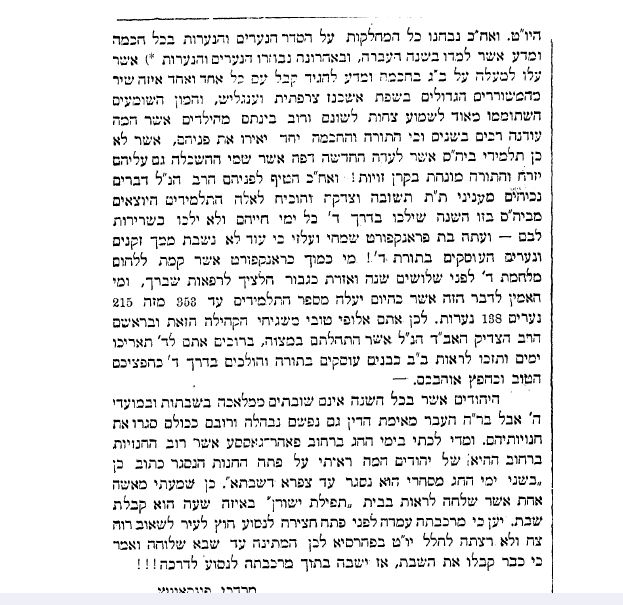
There are many other interesting articles such as on Chasam Sofer and copyright, and others which I will perhaps discuss in a later update.
[*] I mistakenly translated שירים as songs. The report is actually referring to poetry recital. My thanks to Prof. Shapiro for bringing this error to my attention.
Wednesday, June 2, 2010
Chafetz Chaim and Chassidus
Seforim has a nice post on Chafetz Chaim's attitude toward Chassidus. I am not certain why R' Brodt left out the following excerpts from Dugma M'Darkei Avi which show the Chafetz Chaim to have been something of a Misnagid (although his opinion softened somewhat when he saw the Chassidim were a great ally in the struggle against Haskalah).
1 - "Who told you to got to the Shtiblach, I do not deal with them" (the Chassidim). After his son describes some incidents in which Chassidim had disparaged Lithuanian Gedolim.


2 - Against those who daven late with the excuse that it is necessary for proper Kavanos (classic Misnagdic complaint)

3 - Chassdim on the right, Haskalah on the left. Neither is a positive trend. Also, he was shown a Sefer of of the Admorim and said "What is missing in the Torah of the Tannoim and Amoraim" (i.e. who needs this new stuff?)

Although, it must be noted that his son was not a fan of Chassidim (as per story in 1) and is not an impartial observer.
I'd also note that the expressions "Gaon Echad", "Gadol HaDor Echad" and the like appear frequently in the Chafetz Chaim's Shem Olam. It woudl be interesting if someone can identify who this refers to and why the Chafetz Chaim chose to withhold his name.
1 - "Who told you to got to the Shtiblach, I do not deal with them" (the Chassidim). After his son describes some incidents in which Chassidim had disparaged Lithuanian Gedolim.


2 - Against those who daven late with the excuse that it is necessary for proper Kavanos (classic Misnagdic complaint)

3 - Chassdim on the right, Haskalah on the left. Neither is a positive trend. Also, he was shown a Sefer of of the Admorim and said "What is missing in the Torah of the Tannoim and Amoraim" (i.e. who needs this new stuff?)

Although, it must be noted that his son was not a fan of Chassidim (as per story in 1) and is not an impartial observer.
I'd also note that the expressions "Gaon Echad", "Gadol HaDor Echad" and the like appear frequently in the Chafetz Chaim's Shem Olam. It woudl be interesting if someone can identify who this refers to and why the Chafetz Chaim chose to withhold his name.
Thursday, May 27, 2010
R' Kook on natural law and on the importance of open-mindedness
Following is my inexact translation of the first part Chapter 22 of the recently leaked ms. of R' Kook לנבוכי הדור. See here for the background of this book and here for a great analysis of its contents.
The most alarming matter of all, that which causes the great confusion of ideas in this world, and dominates with great commotion - even today the time of the explosion of ideas, is the tendency to limit ones outlook on life within the confines of ones own group.
The delusion of the observer is that in regard to a certain subject, be it in the sphere knowledge, ethics or actions; political or personal, only the particular idea that is beloved by him and is accepted by his group is important, and one need not pay any attention to any of its other aspects. If these other ideas that are not accepted by his group will seek by their nature, to expand, in more detail and to flourish, then there will arise from every side great opposition, as if [this new thing] is coming to swallow and overtake the aspect that is beloved by him.
As is understood this very commotion causes other groups to act in extreme ways as well in order to defend their own party and to view everything coming out of the [other party] as a destructive item that will damage the world, or at the very least, as unimportant or craziness. This trait exists among man in general, and among us the Jewish People in particular.
When will these men open their eyes and see that there is no need for this destruction. We need to add to the structure not lessen. It is enough that we are forced into natural conflict, which becomes necessary when two subjects, each worthy in its own right, come into conflict, and time and strength do not allow both of them to receive their due. Then the question arises which is pushed away before the other. However even this battle must be carefully calculated, so as not to lower unto dust the value of the issue that must be pushed away because the other issue is more important right now. It is the opposite, we must make known that the reason we are pushing away this other subject, which has value to us as well, is not because of there is no merit in acquiring that information, action, or ethics, but because of a lack of ability on our side to accept all the desirable things, so that we must choose one over the other. This is the path of careful thought that is built on foundations of truth which will also bring the blessing of peace on the part of those choosing.
This desire to destroy and to eradicate something where it is not completely necessary, is rooted in the evil inclination of a man, and an exaggerated self-love that causes him to hate everything else. The prohibition “do not destroy” stand up sharply against this character trait. Already, in the earlier days of the expansion of ideas, through the influence of the Haskalah in our nation, there was an explosion of this kind; instances and branches which continue on in each generation.
That which is understood on its own, the personal and pure ethics, and the laws, that is the laws of the Torah, when looked into can easily be seen to be two distinct subjects. But the idea that there must be conflict between them comes only from partisan blindness.
Those with inner understanding that looked into internal ethics and desired [only] the completion of a man through good ethics based on righteous and natural reasoning, when they should realized that the laws [of Torah] provide great assistance in the development of the ethical sense of pure humanity, and so there are many great benefits that the law gives us. Therefore if we are to turn to another group, that in our terms is wider then the simple desire to keep the law alone, it is worthy to constantly seek the path of peace, to keep both benefits at once – the benefits of natural ethics, and of the upkeep of the law. If we were to look into it, we would see that the ethics of keeping the law not only do not encroach on natural ethics but is actually at its base and expands upon it.
Sunday, May 23, 2010
Politics in Satu-Mare: The early career of Rabbi Yoel Teitelbaum
I found an interesting pamphlet on Hebrewbooks - S'fas Emes relating to the controversy surrounding Rabbi Teitelbaum's appointment as Satmar Rav. I'm a little confused as to some of the details (no doubt the official biography of the Rav, Moshian Shel Yisrael provides a more thorough account). But there seems to have been some irregularity in the election. In the usual Hungarian fashion, some suggested that the community be divided in two so both R' Teitelbaum and his opponent (Rabbi Halberstam) could serve as Rabbis.
I assume it is the Munkatcher Rav's involvement here that lead to the kind of tension that caused his Minchas Elazer to be placed on a Satmar גניזה list.
Also interesting is the claim that the R' Teitelbaum's letter was censored - his statement concerning the halachic argumentation of the Rabbi of Bistritz(?) was removed.
Update: Bar Uryan sends us to an interesting Yiddish newspaper that contains "a laundry list of victims of Satmar campaign violence".
I assume it is the Munkatcher Rav's involvement here that lead to the kind of tension that caused his Minchas Elazer to be placed on a Satmar גניזה list.
Also interesting is the claim that the R' Teitelbaum's letter was censored - his statement concerning the halachic argumentation of the Rabbi of Bistritz(?) was removed.
Update: Bar Uryan sends us to an interesting Yiddish newspaper that contains "a laundry list of victims of Satmar campaign violence".
Friday, May 14, 2010
R' Chaim Brisker and the Rogatchover on Chinuch
A very moving letter from R Chaim Brisker on Jewish education. I have not seen this letter reproduced anywhere else. This seems to be written in response against the Maskilim who proposed a "method" (i.e. curriculum) which would involve minimal Talmud study.
Also very interesting is the Rogatchover's letter written in his unique style. A greater Talmud Chacham then I can perhaps let us know what he is trying to tell us. (Presumably the textbooks of the "Methodists" paraphrased the Torah and this is what he refers to as "לכנות פסוק" but I am not sure.)
The note of the "Bucher Zetzer" mentions some parody of these letters in HaMelitz and HaZefirah but I did not have time to try track them down.
This issue is bound together with a short biography of Ridvaz.
[Update: I see now that they must be referring to the same Chumash banned by the Chafetz Chaim posted by S. here]
Also very interesting is the Rogatchover's letter written in his unique style. A greater Talmud Chacham then I can perhaps let us know what he is trying to tell us. (Presumably the textbooks of the "Methodists" paraphrased the Torah and this is what he refers to as "לכנות פסוק" but I am not sure.)
The note of the "Bucher Zetzer" mentions some parody of these letters in HaMelitz and HaZefirah but I did not have time to try track them down.
This issue is bound together with a short biography of Ridvaz.
[Update: I see now that they must be referring to the same Chumash banned by the Chafetz Chaim posted by S. here]
Subscribe to:
Posts (Atom)
